
On a net basis, foreign portfolio investors bought Rs 446 crore worth of domestic stocks on Thursday and domestic institutional investors (DIIs) were net buyers to the tune of Rs 49.68 crore, provisional data available with BSE suggested.
In the broader market, the S&P BSE Midcap ended 0.1% down, while the S&P BSE Smallcap index gained 0.3%.

Over the next three - six months, UBS believes earnings will be the main driver for EM equities outperformance.

'Now is the time for India to course correct and for the government also to course correct,' says businessman Mangesh Khatri.

The biggest gainers on both bourses were Bharti Airtel, HDFC duo, L&T, Bajaj Auto, Kotak Bank, Reliance Industries, Axis Bank, ICICI Bank, SBI, ITC and Bajaj Finance, rising up to 4 per cent.

India, which appears to have been pushed back to being the world's sixth biggest economy in 2020, will again overtake the UK to become the fifth largest in 2025 and race to the third spot by 2030, a think tank said on Saturday. India had overtaken the UK in 2019 to become the fifth largest economy in the world but has been relegated to 6th spot in 2020. "India has been knocked off course somewhat through the impact of the pandemic. "As a result, after overtaking the UK in 2019, the UK overtakes India again in this year's forecasts and stays ahead till 2024 before India takes over again," the Centre for Economics and Business Research (CEBR) said in an annual report published on Saturday. The UK appears to have overtaken India again during 2020 as a result of the weakness of the rupee, it said.
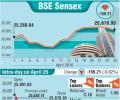
The S&P BSE Sensex ended down 159 points at 25,679.

The rally was led by IT stocks, with TCS and Infosys rising up to 5 per cent. Yes Bank, on the other hand, was the biggest loser on both the bourses, cracking nearly 12 per cent

Investors have turned cautious ahead of the policy meetings of central banks in Japan and the US

Other losers in the Sensex pack included IndusInd Bank, Tata Motors, TCS, Yes Bank and L&T, falling up to 3.26 per cent.

The biggest gainers in the Sensex pack in Friday's session were Yes Bank, Bharti Airtel, Tata Motors, Vedanta, SBI and Axis Bank, spurting up to 3.05 per cent. The losers included HCL Tech, TCS, Infosys, Hero MotoCorp, IndusInd Bank and Sun Pharma, falling up to 1.55 per cent.

Takao replaced Haruhiko Kuroda, who had, in March, quit ADB to take charge as Japan's central bank governor.

HDFC, HDFC Bank, Reliance Industries and Infosys fell up to 2.20 per cent, dragging the indices deep into the red.

However, survey by Japanese firm shows India as most preferred Asian market for Japanese investors.

The IL&FS management is also talking to its second-largest shareholder, Orix Corporation of Japan, to infuse more funds into the company - in case any shareholder backs out during the rights issue.

Among sectoral indices, telecom led the chart, spurting 3.08 per cent, followed by oil and gas.

He cited demonetisation, 'wrong' GST and the lockdown as three examples of government's attempt to destroy the informal sector, that provides 90 per cent jobs to people.
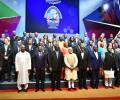
The pitch comes close on the heels of China launching its multi-billion dollar OBOR initiative
IndusInd Bank was down nearly 1% even after it reported a 21% rise in its fourth-quarter profit

Addressing a G20 Summit session, Modi also presented his '5-I' vision to maximise digital technology for social benefit.

In December, over 1.7 million people have checked in over the weekends.

Yoga guru Baba Ramdev's Patanjali Ayurved on Wednesday made its first big acquisition when it paid Rs 4,350 crore to take over soya food brand Nutrela-maker Ruchi Soya through an insolvency process. The acquisition will help Patanjali acquire edible oil plants as also soyabean oil brands such as Mahakosh and Ruchi Gold.

The dollar gained strength with the emergence of the US as the only developed economy showing signs of recovery.

Tata Steel was the biggest gainer in the Sensex pack, rising 3.36 per cent, followed by Vedanta, Bajaj Finance, TCS, IndusInd Bank, Infosys, ONGC, Kotak Bank, HDFC Bank, HDFC, M&M and ITC.

Takahide Kiuchi, Senior Economist, Nomura Securities believes that Bank of Japan is likely to take a 'wait and watch' stance on rates.

Top gainers of the session included Bajaj Auto, Kotak Bank, M&M, Vedanta, IndusInd Bank, Asian Paints, HDFC Bank, Reliance Industries, HUL, HDFC, ITC, Tata Steel and Tata Motors, rallying up to 5 per cent.
Other gainers included Kotak Bank, HCL Tech, ONGC, Asian Paints, Vedanta, HDFC Bank, Bajaj Finance, Maruti and TCS, gaining up to 1.41 per cent. Sun Pharma was the top loser, cracking 8.58 per cent.

In the Sensex pack, Axis Bank, HCL Tech, M&M, TCS, HDFC, Kotak Bank, PowerGrid, Hero MotoCorp and Vedanta were among the top gainers, rising up to 1.91 per cent. Sun Pharma was the biggest loser, cracking 5.78 per cent.
There were more than three losers against every gainer on BSE

Sectors such as Auto, Banks, Capital Goods, FMCG, Metal, Oil & Gas and Power are trading marginally lower.
Sectorally, metal and banking stocks rallied the most, while FMCG and realty stocks came under selling pressure.

'The growth drivers are mostly invisible, but the growth is undeniable at least for now,' notes Debashis Basu.

At 12:25 PM, the barometer index, the S&P BSE Sensex was down 358 points or 1.3% at 26,368.

According to the data available on the Reserve Bank of India's website, net workers' remittances in April-June 2018 were $11.5 billion

The official told the reporters during a conference call on Friday, ahead of the next week's 2+2 India-US Ministerial in New Delhi, that the Trump administration was providing support to India through defence sales, joint military exercises and information sharing.

All sectoral indices on the BSE and NSE ended in the red, led by realty, banking, metal, pharma, pharma and financial stocks.
BSE IT index was the biggest sectoral loser, down 1.5% dragged by TCS

A common factor that binds all these men is greed.
In the broader markets, the BSE Midcap and Smallcap indices were up 0.5% each

While Nifty 50 reflects changes in 40 years, it also shows what is missing: Low-cost manufacturers at one end, and deep-value players at the other. Also missing are technology players, observes T N Ninan.
 © 2026 Rediff.com - Advertise with us - Disclaimer - Privacy Policy - Sitemap - Feedback - About us - Terms of use - Grievances